Reading Japanese Auction Grade Sheets
What does the “grade” mean?
An auction grade sheet is a document which almost all Japanese vehicles that are sold in auctions in Japan have included, in order to be sold in the sale.
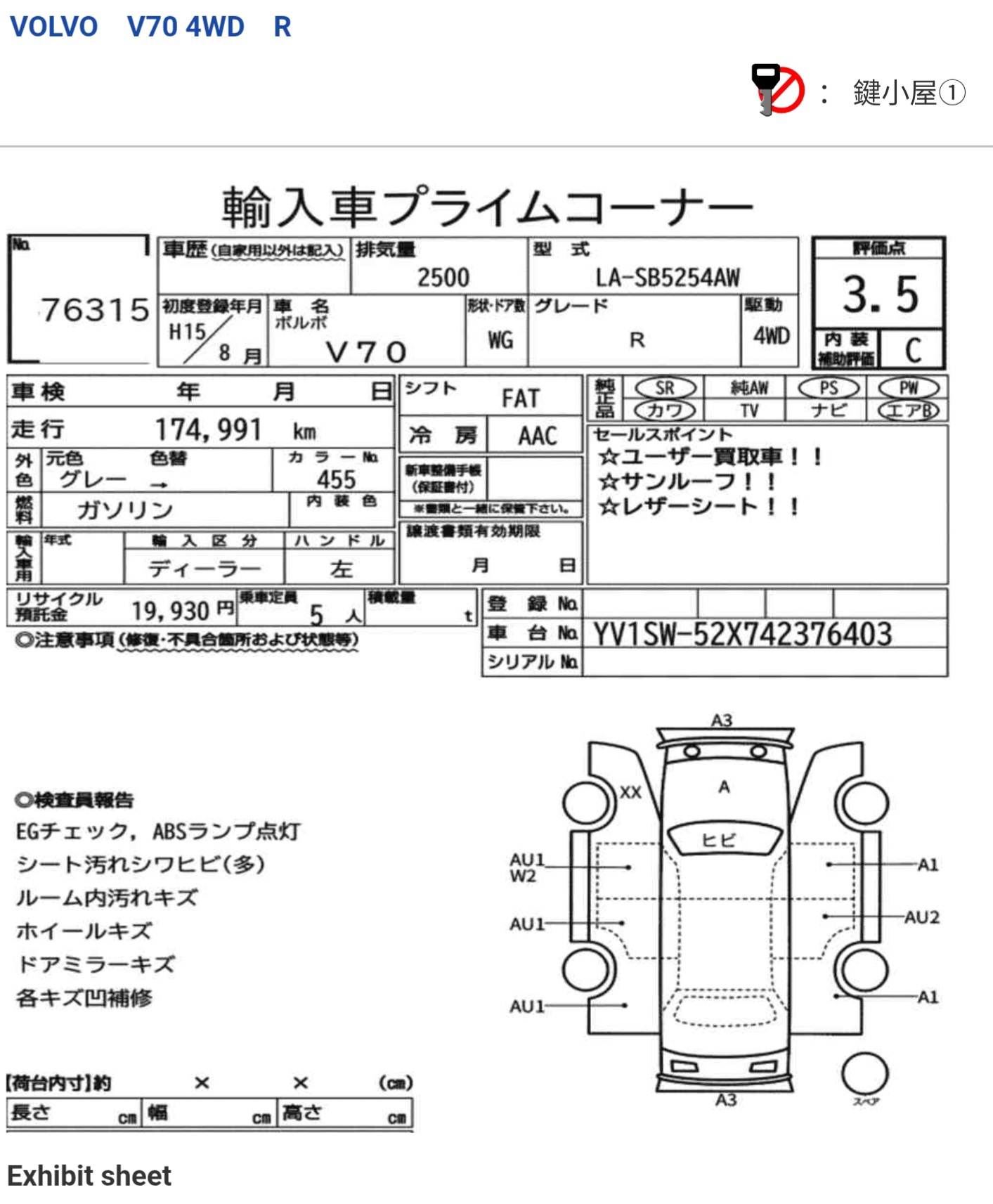
These sheets are written by inspectors at each individual auction house who assess each vehicle one by one before the sale. This assessment looks over the vehicle for any marks such as scratches or dents, or any obvious issues and defects. Each car is given an overall “Grade” usually found in the top right corner of most auction sheets in a box . Many importers refer to these grades when selling a car, and you will see things such “grade 4.5 car” listed.
These however, can only ever be used as a guide and are not the be all and end all of a cars story.
They are written by different inspectors at different auctions, and are the inspectors personal views – some can be more or less strict. So a grade 3.5 car at one auction may not be as good as a grade 3.5 at another auction. One inspector might see a car as a grade 4, where another might rate it a 3.5.
They are broad comments, and give an overall understanding of the inspectors view on the cars condition and in no way constitute a thorough inspection.
The inspector often notes any sales points, such as “One Owner” or “Uprated Stereo” in a box, normally directly below the grade mentioned above. They then write generic comments on the condition of the vehicle on the bottom left of the sheet, things such as “Interior dirty” or “paint peel on door handle” These comments are often much more use than the grade itself.
In summary, these sheets are just a guide to help us get a picture of the overall condition of the vehicle, but they are subjective.
A more thorough inspection, which can be arranged by Origin Japan before the auction, is always advisable especially for older vehicles.
So what are the grading levels?
Exterior – The inspector marks any obvious marks, such as scratches, dents or scuffs on a picture of the car from above, with the front at the top. This is generally on the right hand side of the grade sheet towards the bottom. These detailed are marked with abbreviations, which translate as the following:
S / 6 – The vehicle has a maximum age of less than 12 months from the date of its initial registration and is in pristine condition both internally and externally.
5 – This grade is extremely challenging to achieve, and the vehicle will be in almost perfect condition with minimal imperfections.
4.5 – A highly respectable grade that instills confidence. The car may have minor blemishes on its bodywork, and the mileage will be higher than a grade 5.
4 – The exterior may contain minor scratches and dents, but the vehicle is in above-average condition and often accompanied by maintenance records. If necessary, only minor maintenance/repairs will be required.
3.5 – This is the most common auction grade and encompasses a wide range of conditions. We highly recommend obtaining a professional pre-bid inspection from a third party, especially for vehicles with grades of 3.5 or lower, to confirm their condition. Standard maintenance will be necessary, and minor repairs may also be required.
RA – The vehicle has suffered minor accident damage, but has been repaired effectively. Other than the minor damage and repairs, the condition can be as good as a grade 4.5. An inspection is definitely worthwhile.
3 – The exterior displays multiple noticeable large scratches, scrapes, paint blemishes, and/or dents that will require bodywork and/or painting. The interior is likely to have a combination of tears, cigarette burn marks, and/or stains. Repairs, both internally and externally, will be necessary to varying degrees for these vehicles.
R – The vehicle has a history of accidents, and the damage may or may not have been repaired. Similar to grade 3.5, the range of condition is extensive, and we recommend conducting an inspection. The inspectors will be able to provide information on the location and severity of the damage. This can also be attributed to some highly modified vehicles.
2 – The vehicle has significant corrosion holes.
*** / 0 /無効/ Blank Grade – Any of these marks indicate one or more of the following: 1. The vehicle has not undergone inspection by the auction house. 2. The vehicle has sustained major accident damage. 3. The vehicle is inoperable. 4. No claim, sold “as is.”
We can typically arrange for inspections for these grades.
Possible reasons for a 無効, in order of likelihood:
The vehicle is simply too old to confirm.
The seller chose this listing method as it is the most cost-effective.
Accident damage (if the photos were taken outdoors, more likely).
Inoperable (if the photos were taken outdoors, more likely).
No time to inspect the vehicle before the start of the auction.
Modifications that cannot be verified.
Flood damage.
# / $ / * – The mileage has not been verified. If any of these symbols appears next to the listed mileage, it means that the auction house cannot confirm the vehicle’s mileage. This could be due to an odometer swap, a 5-digit odometer, or simply because the
Interior – These grades are often written below the auction grade in the top right of the sheet. Interior grades are A through E, with A being the best condition.
What do all the little abbreviations mean?
As well as the overall grade and the comments, the inspector will visually mark any obvious damage on the car on a little plan on the sheet.
This is so we can know what to expect to see and where it is on the vehicle. The plan of the car is always bonnet to the top of the sheet and marks are placed on the corresponding panel on this plan with a severity rating, normally 1-3 with 3 being the most severe.
So, for example, a defect on the front right drivers side wing would be on the top right hand side of the image.
Marks all have their own abbreviations which mean different types of damage and they are translated as follows:
Auction Sheet Abbreviations
AC – Air conditioner
FA/AT – Automatic transmission
F5 – Manual (5-speed) transmission
PS – Power steering
SR – Sunroof
AW – Alloy wheels
AAC – Climate control air conditioner
CA – Column automatic transmission
F6 – Manual (6-speed) transmission
PW – Power windows
TV – Television
カワ・革 – Leather seats
エアB – Airbag
E3 – Some dents which are barely visible.
U1 – A dent which is the size of a thumb.
U2 – A dent which is the size of a palm.
U3 – A dent which is more than size U2.
Y1 – A tear which is the size of a thumb.
Y2 – A tear which is the size of a palm.
Y3 – A tear which is more than size Y2.
W1 – A panel which has been repaired slightly, and is in good condition.
W2 – A panel which has been repaired slightly, and has a slightly wave.
W3 – A panel which has been repaired slightly, and has a conspicuous wave.
S1 – Rust which is the size of a fist.
S2 – Rust which is more than size S1.
C1 – Major rust corrosion which is the size of a fist.
C2 – Major rust corrosion which is more than size C1.
X – A panel which needs to be replaced.
XX – A panel which has been replaced.